 Emulsion Tubes
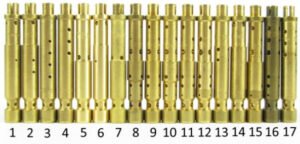
Emulsion Tube selection goal is apparently to use the leanest option that gives your engine the best all round performance. cc sizes mentioned are per cylinder.
Most references state that the Dellorto emulsion tubes go from Rich to lean by part number with 7772.1 being the richest and 7772.16 being the leanest.
Des Hammill recommends:
Standard Engines 250cc – 500cc
7772.10 or 7772.8 are considered the recommended starting point.
Racing / Modified Engines:
250cc to 325сс – 7772.8 (Weber F11)
275cc to 400сс – 7772.7 (Weber F15)
350cc to 475cс – 7772.6 (Weber F16)
450cc to 575cc – 7772.5 (Weber F2)
Dave Andrews often appears as a reference point online in relation to the 4 Cylinder Pinto Engines. He recommends the same Emulsion Tubes as Des does for Modified Engines.
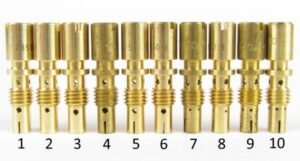 Idle jet Holders (idle Emulsion Tubes)
Idle jet holders in order of mixture Weak 5-10-9-4-1-3-6-7-2-8 Rich – Only to be used with pre- emission variation DHLAs
DHLA40 – no letter
DHLA40 C
DHLA40 E
DHLA40 H turbo
DHLA45 – all types
DHLA48 – all types
For all other variations use part number 10738 (Sometimes referred to or labelled as 7850N)
The Dellorto idle jet holder is used to fine tune the air/fuel mixture sent to both the idle circuit and the progression holes. For performance engines, these can be narrowed down to 7850.1, 7850.6, 7850.2, 7850.8 (lean to rich). Regardless of engine capacity, it is recommended to start with the leanest option.
With the idle jet selected from the list further above, the air bleed factor is then increased or decreased by changing the holder.
Initial Idle Set up
Turn the idle mixture adjusting screws 2.5 turns out from the “lightly seated” or fully in position. (Be gentle with them) The engine should start on this setting but it may not run smoothly.
Once the engine has warmed up, set the idle speed to 1000rpm (or your engines preferred idle speed), and then turn all of the idle mixture adjusting screws out a further 0.5 turn. Allow at least 10 seconds for the carbs to respond to the adjustment and If the idle smoothness and rpm improves then reset the idle speed back to 1000rpm and repeat this process until you reach the point where the idle smoothness worsens when you add half a turn.
Once half a turn out worsens your idle, reduce it back to its previous setting by that same half a turn.
If you get to 4 full turns out before you find the point when your idle worsens then increase the idle jet size and start over.
As a guide, anything beyond a total of 3 3/4 turns out probably means larger idle jets would be better. Anything less than 2 turns probably means a smaller idle jet should be used. Either way this roughed in idle setting should allow you to balance the carbs.
Spitting back through the back of the carb normally indicates that the mixture is too lean, or the timing is hopelessly retarded.
Idle jet and Air Bleed tuning
The idle jet and holder assembly are the key to smooth part throttle driving and acceleration. Getting this right is critical to off-idle progression between closed throttle and the main jet circuit. If this circuit is too lean then the engine will stutter or nosedive when opening the throttle, too rich and the engine will hunt and surge especially when hot.